In its draft budget for 2027, the government does not plan to continue consolidation, even though the measures taken so far have not been sufficient to halt the growth of debt, to which it committed itself in the Programme Statement of the Government[1]. According to the CBR estimate, the draft budget instead worsens long-term sustainability. The need for further measures is being shifted to subsequent years, when higher debt and rising debt service costs, a record-high tax burden and a more slowly growing economy will make fiscal repair even more difficult.
At the same time, the government repeatedly fails to meet its budget targets and is retreating from the originally declared pace of fiscal consolidation. As recently as 2024, it set the deficit target for 2027 at 3% of GDP and subsequently raised it gradually to the current 4.9% of GDP, which means missing the original target by almost EUR 3 billion. Previous budgets did not contain sufficient measures to meet the targets in subsequent years either, and this shortcoming persists in the current draft. The government also attributes its failure to meet the set targets to unfavourable developments in the external economic environment, but it has not presented a transparent quantification of their contribution or a breakdown of the other causes of non-compliance. The performance of the domestic economy is, however, also affected by the scale and composition of consolidation measures. Repeated failure to meet the originally set targets, together with the lack of measures to achieve them, undermines the credibility of budget planning.
Consolidation to date has imposed tangible costs on households and businesses, which are not matched by the extent of the lasting improvement in public finances. The measures have focused mainly on increasing taxes and contributions, while their composition, as well as recurring annual uncertainty, has dampened economic growth and investment activity. A significant part of their favourable budgetary effect has been absorbed by new expenditure, and part of the revenue was only temporary. The need for further consolidation therefore remains high even after several packages. Prolonging the entire process increases the risk of consolidation fatigue and loss of public support, as households and businesses are already bearing the costs of the measures, yet the stabilisation of public finances remains distant. At the same time, uncertainty about the future development of taxes and public services persists.
The consequences of the draft budget extend beyond 2027. Increasing permanent expenditure without corresponding permanent financing and the gradual loss of temporary revenue are burdening future budgets. Without additional measures, the deficit will rise to 6.1% of GDP by 2029. Yet the draft does not specify the measures needed to achieve the declared targets for 2028 and 2029. The submitted multi-annual framework thus does not demonstrate how the government will ensure a correction. What is missing is a strategy based on specific and quantified measures that would set out their timing, take into account their economic and social consequences and create a credible path towards debt stabilisation.
The draft budget does not yet build on Vision Slovakia 2040 (Vízia Slovensko 2040), which the government itself approved only a few weeks earlier. The Vision envisages a gradual move towards a balanced budget and a decline in public debt below 50% of GDP. Nor does the budget significantly reflect the long-standing recommendations of the Council of the EU and the OECD to better target social transfers and to shift a larger part of consolidation to structural measures on both the expenditure and revenue sides. The draft thus does not yet show reform steps that would support competitiveness and higher growth and improve the health of public finances.
A sustainable improvement in public finances requires both a lasting reduction in the deficit and support for the economy’s growth potential. Economic growth alone, under the current setting of revenue and expenditure, is not sufficient to halt the growth of debt. It will therefore be crucial whether the government presents feasible measures with a lasting effect, limits the adoption of new unfunded commitments and chooses an approach that weakens investment and productivity as little as possible.
Government draft budget
The draft general government budget for 2027–2029 was approved by the government on 5 October 2026, midway through the first working day after the budget had been published. It was then immediately referred to the ongoing 61st session of the National Council of the Slovak Republic[2].
After three rounds of consolidation, the government declares in the draft general government budget for 2027–2029 a slight loosening of fiscal policy in 2027 and postpones the return to consolidation to subsequent years. It justifies this approach by unfavourable economic conditions and geopolitical uncertainty. Compared with its plan of April 2026, the government has loosened the target by EUR 1.1 billion, even though the forecast of tax and social contribution revenue has improved in the meantime and forecast economic growth will double year on year compared with 2026.
Compared with last year’s draft budget, the emphasis of the government’s declared fiscal strategy is thus changing. Only a year ago, the budget for 2026–2028 stressed the necessity of continuing consolidation in order to reduce the deficit below 3% of GDP by 2028 and to stabilise debt developments. The current draft, by contrast, places greater emphasis on financing government priorities and allows for a deviation of almost EUR 3 billion from the original target of 3% of GDP[3]. The government is thus presenting a budget that has completely abandoned the stabilisation of public debt, even over the postponed medium-term horizon up to 2029.
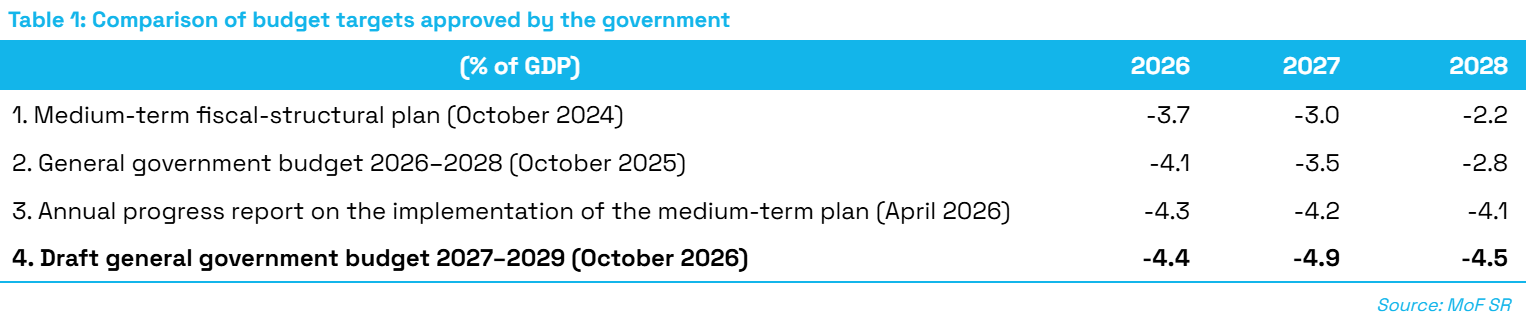
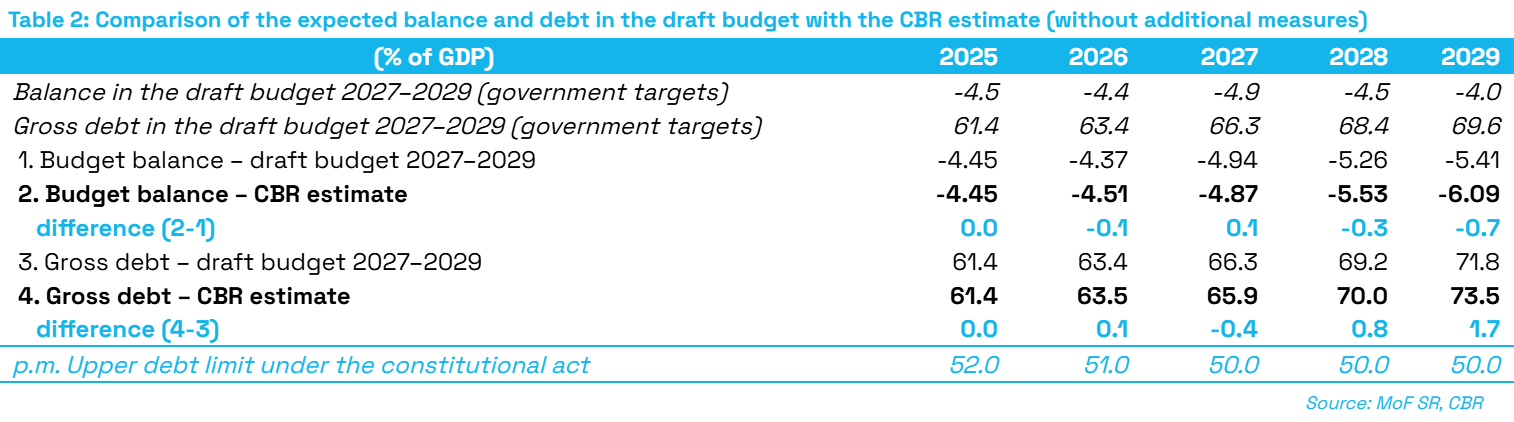
In 2026, compared with the originally budgeted general government deficit of 4.1% of GDP, the government currently estimates the deficit at 4.4% of GDP. The draft budget for 2027 assumes a deficit of 4.9% of GDP. In subsequent years, budgeted revenue and expenditure lead to a further increase in the deficit to 5.3% of GDP in 2028 and 5.4% of GDP in 2029.

At the same time, the government declares a target of reducing the deficit only to 4.5% of GDP in 2028 and 4.0% of GDP in 2029. However, the draft budget does not contain the additional measures needed to achieve these targets. The difference between the budgeted deficit and the declared target amounts to 0.8% of GDP in 2028 and 1.4% of GDP in 2029[4].
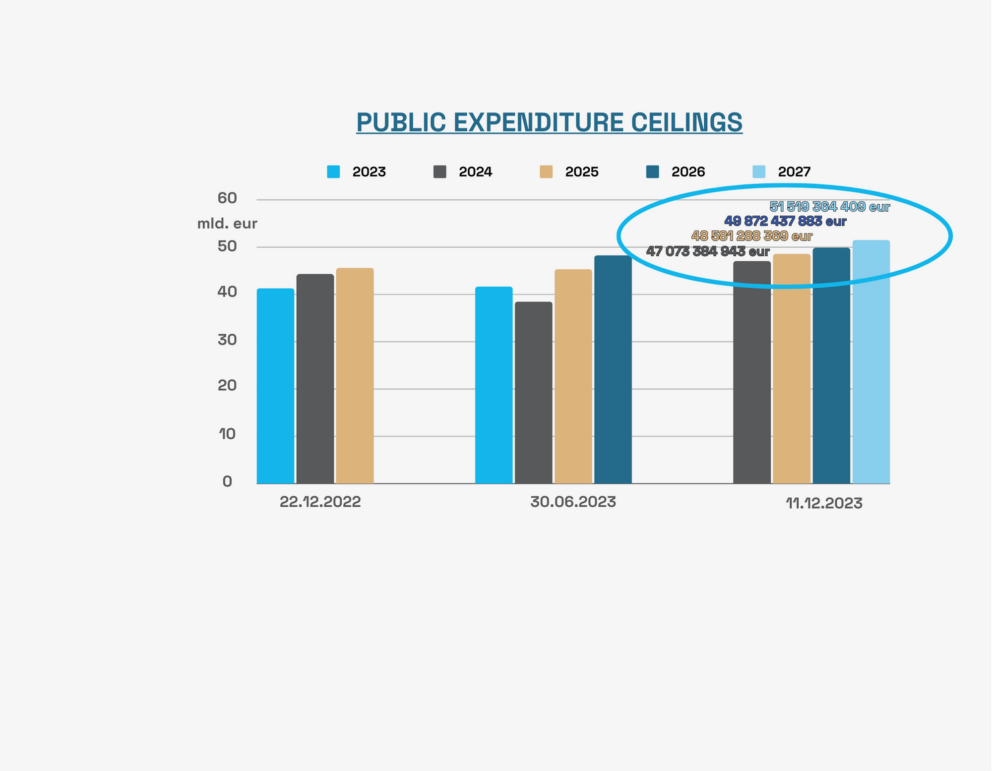
According to the Ministry of Finance, the draft budget for 2027 complies with the (incorrectly calibrated) European net expenditure growth path, making use of the national escape clause for defence expenditure. The government states that, in setting the deficit, it does not make full use of the room provided by this clause. Expenditure falling under the expenditure ceiling is EUR 474 million lower in 2027 than the calculated ceiling. In 2028 and 2029, however, it exceeds the ceiling according to the draft by EUR 458 million and EUR 2.78 billion, respectively. Further consolidation measures will therefore also be needed to comply with the expenditure ceilings in these years.
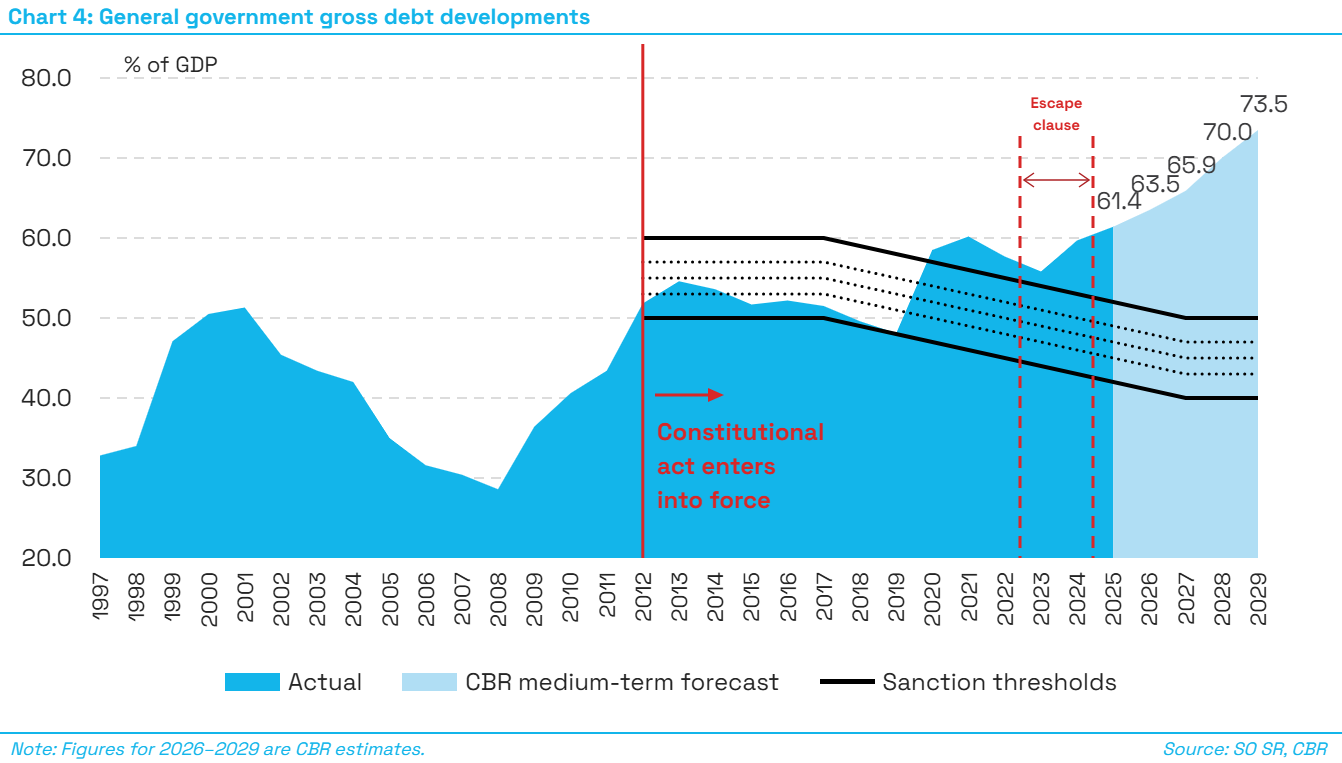
The gross debt forecast in the draft budget assumes an increase from 61.4% of GDP in 2025 to 63.4% of GDP in 2026 and 66.3% of GDP in 2027. The subsequent rise to 68.4% of GDP in 2028 and 69.6% of GDP in 2029 is conditional on achieving the declared deficit targets, i.e. on adopting additional consolidation measures that have not yet been specified. Without these measures, the Ministry of Finance projects debt at 69.2% of GDP in 2028 and 71.8% of GDP in 2029. Regardless of the projected debt path, debt has exceeded the upper limit of the sanction thresholds of the constitutional act since 2020 and, according to the government, will remain above this limit throughout the forecast period, moving significantly further away from it.
Even if the government’s declared budget targets are achieved, gross debt will continue to rise from 63.4% of GDP in 2026 to 69.6% of GDP in 2029. It follows that with this draft budget, the government still fails, even belatedly, to comply with the applicable debt brake sanction, which requires the submission of a proposal of measures to reduce debt.
CBR evaluation
- The year 2026 is the starting point for the preparation of the Draft General Government Budget for 2027–2029. Based on current information, the deficit in 2026 may reach 4.5% of GDP according to the Council[5]. Compared with the government’s current estimate, this represents a less favourable starting position (the deficit estimated by the Council is higher by 0.1% of GDP).
- According to the Council’s estimate, the deficit in 2027 may reach 4.9% of GDP, which is 0.1% of GDP less than the budget target. The Council’s estimate assumes that the budgeted reserve for adverse economic developments will not be used and takes into account the expected reduced volume of defence expenditure. From this perspective, and on the basis of currently available information, the intention to achieve a deficit of 4.9% of GDP in 2027 can be assessed as realistic.

- The following downside risks were identified within the budget structure:
- Underestimation of local government expenditure (EUR 436 million): the CBR forecast expects a slight slowdown in capital spending in 2027 following the year of the 2026 municipal elections, but does not assume savings as large as those in the government budget. Slightly higher spending is also expected in current expenditure items, in particular compensation of employees, where wage indexation in regional education has been announced, as well as an increase in the number of regional education staff. Compared with the assumptions of the draft budget, the CBR also assumes higher purchases of goods and services at the local government level.
- Higher healthcare expenditure (EUR 111 million): the CBR forecast is based on slightly higher estimated spending on healthcare in 2026, which also carries over into subsequent years. At the same time, the CBR assumes that payouts to shareholders of private health insurance companies will continue at the levels of previous years, whereas the draft budget does not envisage such a transaction.
- Lower non-tax revenue (EUR 58 million): the negative impact of EUR 100 million compared with the draft budget relates to the assumed non-realisation of a reimbursement from the European Peace Facility, in view of the published position of the Ministry of Defence of the Slovak Republic. This shortfall is partly offset by higher expected revenue from administrative fees, where the CBR relies on the ongoing collection trend.
- The downside risks mentioned above are offset by positive deviations:
- Lower current expenditure of the state budget (EUR 244 million): the CBR expects a lower level of operating expenditure (expenditure on wages and on goods and services) and of expenditure on subsidies compared with the budgeted amount. The current CBR estimate is based on spending developments in 2026 and current macroeconomic assumptions, and includes adopted measures, including the new expenditure presented in the draft budget (in particular expenditure on wage indexation, anti-drought measures and expenditure related to the national nuclear programme).
- Lower capital expenditure of the state budget (EUR 196 million): the difference stems mainly from a different view of the timeline of hospital investments. The draft budget assumes a significant year-on-year increase in the transfer financing this expenditure in 2027 to EUR 608 million, followed by a sharp drop to EUR 374 million in 2028 and to zero in 2029. By contrast, in view of historical experience with slower and more even implementation of investment projects, the CBR expects a capital transfer of EUR 377 million in 2027, with expenditure remaining at similar levels in subsequent years. The saving compared with the 2027 budget is therefore temporary and implies a downside risk for 2029.
- Non-use of budget reserves (EUR 176 million): the CBR identifies a possible significant saving within the current reserves of the state budget, which are assumed not to be used for expenditure. This concerns mainly the reserve intended to address adverse impacts of budgetary developments, which is budgeted at EUR 150 million.
- Higher tax and social contribution revenue (EUR 155 million): in its tax forecast, the CBR expects corporate income tax revenue to be higher than in the proposed budget by EUR 122 million. This increase relates to higher estimated tax revenue in 2025, which subsequently also carries over into the forecast for the following years. The higher estimated corporate tax revenue in 2025 reflects the latest collection data, which were not known at the time the draft budget was prepared. The CBR also expects more favourable developments in VAT, for which it forecasts revenue higher by EUR 79 million.
- The expected deficit is rising in 2027 despite the assumed reduction in public investment. Compared with average investment excluding defence and EU funds over the last four years of 2.5% of GDP, the level estimated by the CBR of 2.0% of GDP is lower by EUR 624 million, which contributes to a temporary reduction in the deficit. The draft budget itself assumes a more pronounced year-on-year decline in domestic investment from the expected 2.7% to 2.2% of GDP, which implies a decline of EUR 412 million compared with the long-term average.
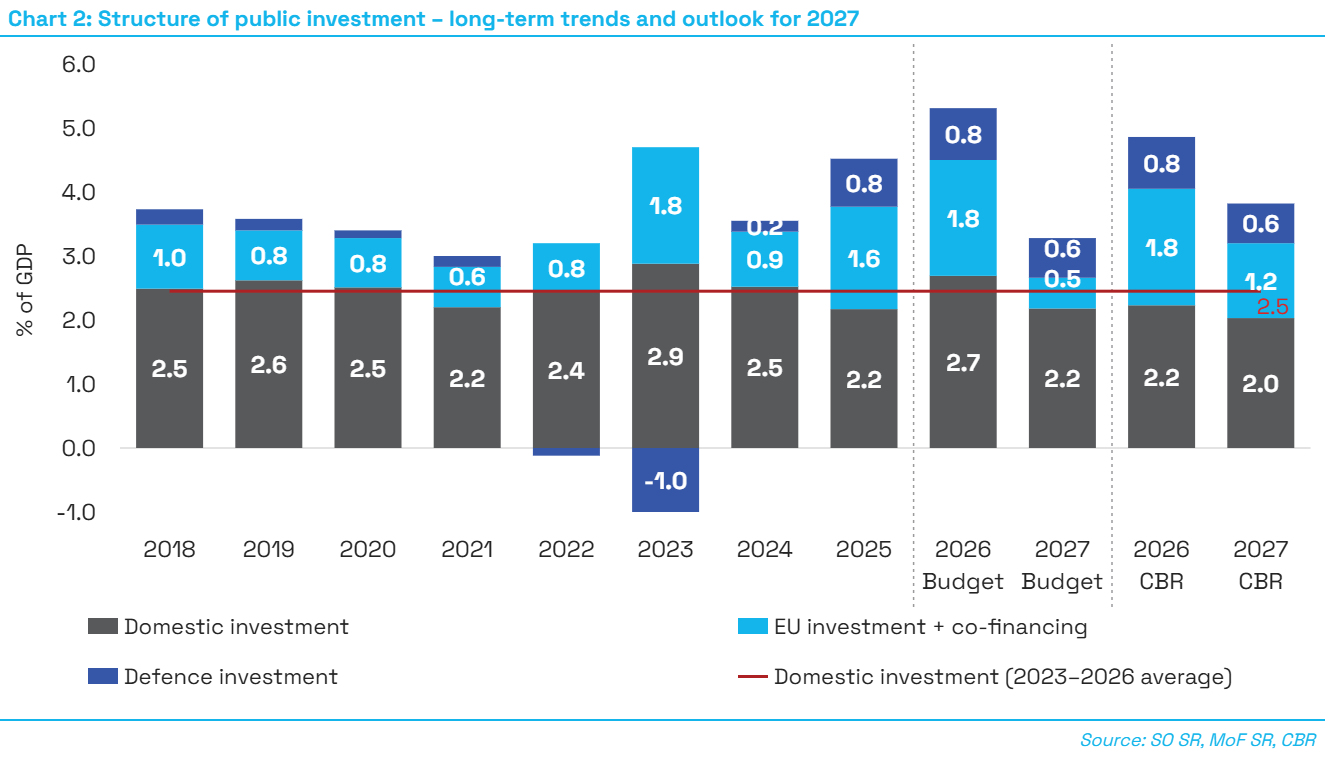
- For the purposes of this evaluation, the CBR assumes defence expenditure developments in line with the draft budget, but at the same time draws attention to the risks associated with this area of public finances:
- The 2027 budget assumes a temporary decline in defence expenditure. According to the budget, defence expenditure under the COFOG classification of the functions of government in the ESA 2010 methodology falls from EUR 2.8 billion in 2026 to EUR 2.5 billion in 2027[6]. The decline is temporary and relates mainly to a reduction in investment from approximately EUR 1.2 billion in 2026 to EUR 920 million in 2027, followed by an increase to EUR 1.5 billion in 2028 and EUR 1.9 billion in 2029. According to an alternative estimate compiled from information on military equipment reported in the media, investment in 2027 could reach approximately EUR 1.4 billion, which would mean exceeding budgeted expenditure by EUR 437 million (0.3% of GDP).
- Additional uncertainty relates to the timing of deliveries of military equipment. Payments for its procurement may be made in advance, but under the ESA 2010 methodology the expenditure is reflected in the deficit only upon delivery[7]. A higher volume of deliveries in 2027, whether as a result of earlier delivery or a shift from 2026, could therefore increase the deficit even without an increase in cash expenditure in that year. Postponing deliveries does not represent a permanent saving, but rather a shift of their impact on the deficit to subsequent years.
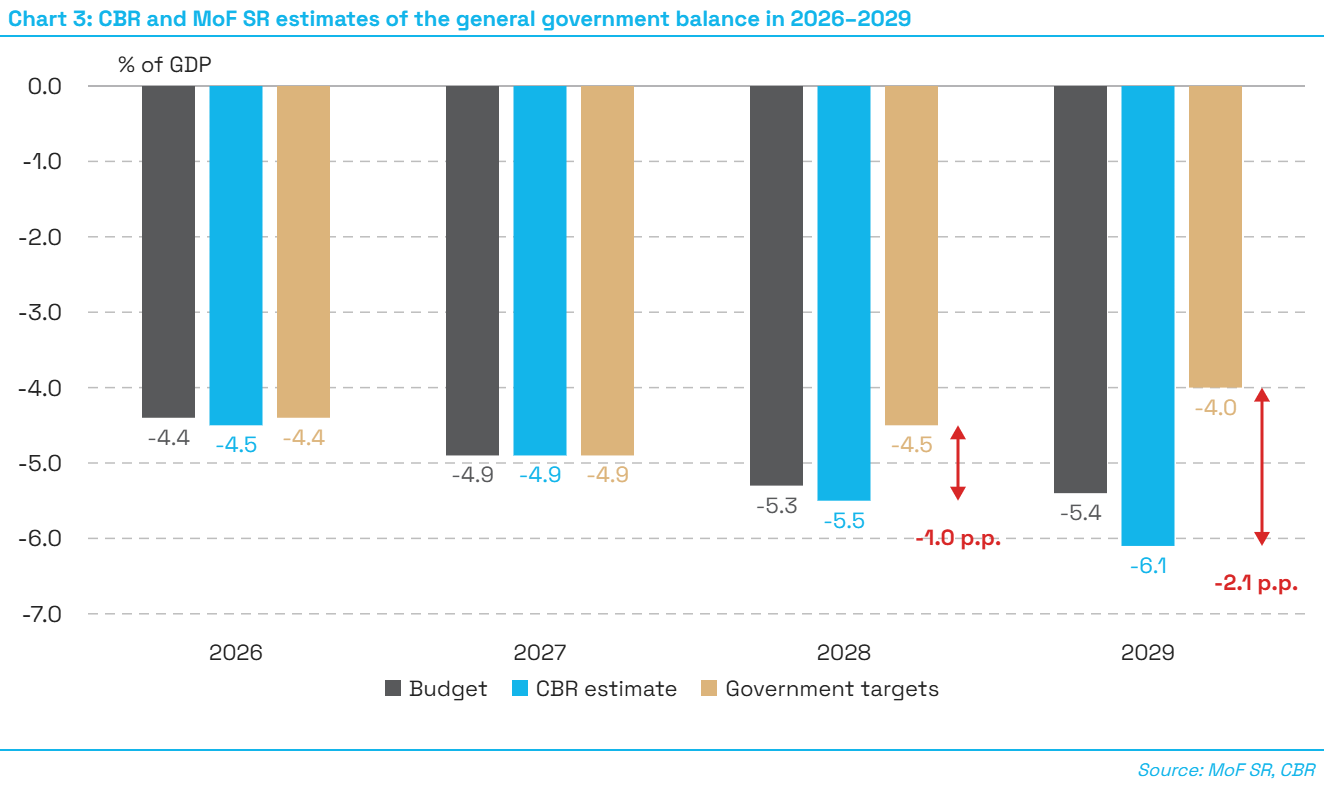
- In subsequent years, the CBR estimates under unchanged policies an increase in the deficit to 5.5% of GDP in 2028 and 6.1% of GDP in 2029. The CBR deficit estimate is higher than in the government’s draft budget by 0.3% of GDP in 2028 and by 0.7% of GDP in 2029. Moreover, compared with its declared targets, the government lacks specified measures worth 1.0% of GDP in 2028 and an additional 1.1% of GDP in 2029.
- If the announced abolition of the transaction tax from 2028 goes ahead and some expenditure continues after 2027 (a new nuclear power plant[8], addressing climate change[9]) without its impact being offset, the deficit could reach 6.0% of GDP in 2028 and 6.5% of GDP in 2029.
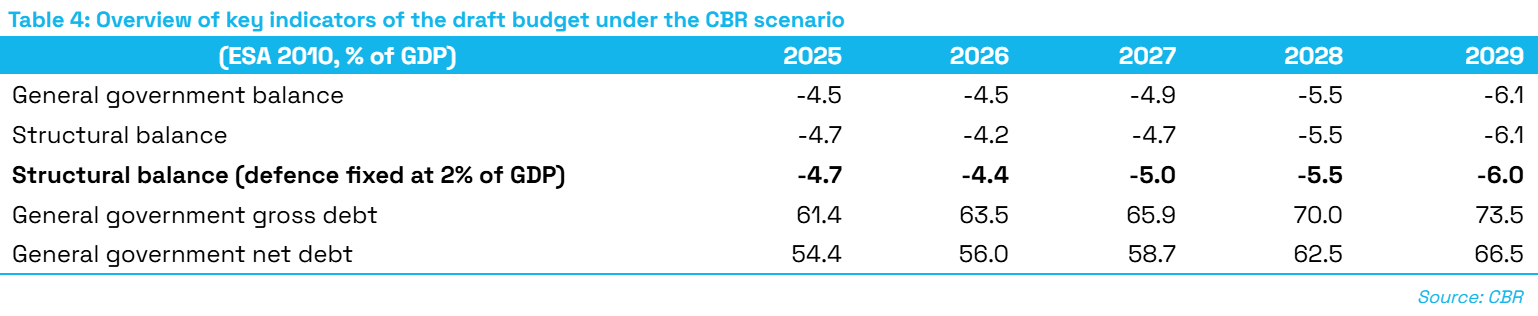
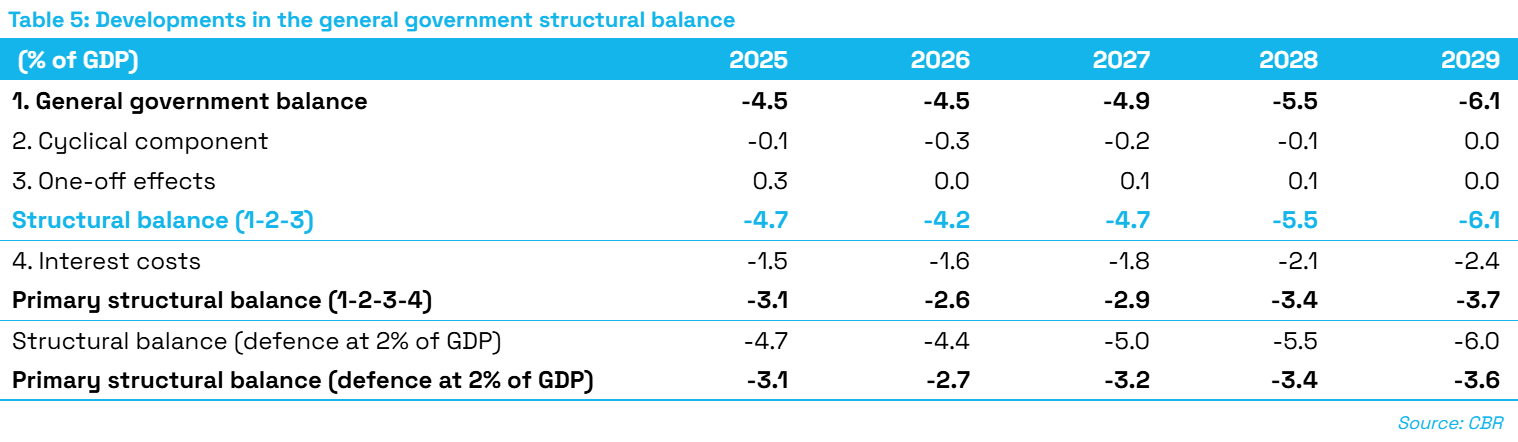
- According to the Council’s estimate, the structural deficit will reach 4.2% of GDP in 2026, a temporary year-on-year decline of 0.4 p.p. of GDP. The improvement will be driven by the government’s consolidation measures adopted in 2025 and lower defence expenditure. In 2027, however, the structural deficit will deepen by 0.5 p.p. of GDP to 4.7% of GDP, mainly as a result of the government’s expansionary fiscal policy and the interruption of consolidation. In subsequent years, its deepening will be driven by rising interest costs[10], newly adopted government measures with a permanent negative impact on the general government balance[11], as well as the expiry of measures that increase budget revenue only temporarily[12]. Without the adoption of additional measures, the structural deficit will thus reach 1% of GDP in 2029. Taking risks into account, the structural deficit could reach as much as 6.5% of GDP.
 According to the European Commission, Slovakia also recorded the fourth-highest primary structural deficit in 2025, which is the main reason for the unsustainable increase in debt in the future.
- The CBR estimates that during 2026 the gross debt-to-GDP ratio will increase from 61.4% of GDP to 63.5% of GDP. It will then rise to 65.9% of GDP in 2027.
Next year, Slovakia will thus reach debt of EUR 98.4 billion, while the safe debt level is estimated at around EUR 74.7 billion. - Over the medium term, without fiscal consolidation after 2027, gross debt would continue to rise sharply, reaching 73.5% of GDP at the end of 2029. In this scenario, net debt would reach 66.5% of GDP, an increase of 12.1 p.p. compared with the end of 2025.
- To stabilise gross debt, the general government deficit needs to be reduced to approximately 2.5% of GDP; in 2027, public finances are EUR 3.5 billion away from this target. With a corresponding consolidation effort, gross debt would stabilise over the medium term at approximately 66% of GDP[13].
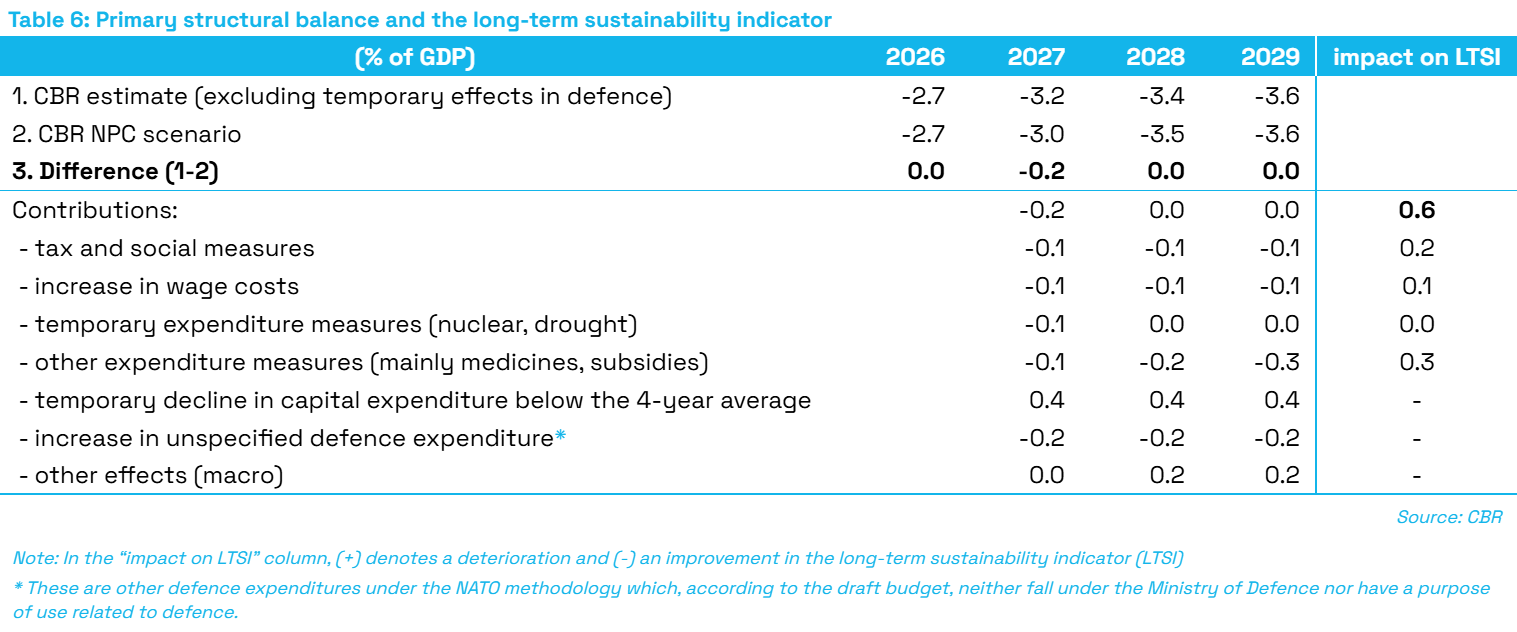
- According to the CBR estimate, the draft general government budget worsens the long-term sustainability indicator by 0.6 p.p. of GDP compared with the no-policy-change scenario. The deterioration is driven mainly by the agreed increase in public sector wages, measures in the social[14] and tax areas, additional expenditure resulting from the approved amendment to the Act on Medicinal Products and compensation of costs for energy-intensive companies. The impact of these measures on the budget balance is partly mitigated by temporarily lower investment. However, a decline in investment below its four-year average cannot be considered a permanent saving and therefore does not improve long-term sustainability. In constructing the baseline scenario, the CBR therefore uses the four-year average of selected investment expenditure, thereby limiting the effect of its year-on-year fluctuations on the sustainability assessment. Nor does a temporary increase in economic activity and budget revenue induced by the fiscal expansion represent a permanent improvement in public finances; it is therefore not reflected in the change in the indicator.
Beyond this estimate, long-term sustainability could worsen by a further 0.4 p.p. of GDP if additional risks were to materialise and their impacts were not offset by permanent measures. These include the possible abolition of the financial transaction tax and the continuation of expenditure related to climate change and nuclear energy after 2027.