Summary
The Report on Compliance with the Fiscal Responsibility and Fiscal Transparency Rules annually assesses, by 31 August, compliance with the rules arising from the constitutional Fiscal Responsibility Act[1] in the preceding year. The assessment also takes into account events occurring in the current year up to the report’s cut-off date, if they are relevant to assessing compliance with the rules or to the completeness of the assessment. The report focuses in particular on the development of the long-term sustainability of public finances, compliance with the debt limit and the public expenditure ceiling, the rules applicable to local government, and compliance with fiscal transparency requirements.
Long-term sustainability of public finances
The key objective of the fiscal responsibility rules is to ensure the long-term sustainability of public finances. Safeguarding the long-term sustainability of Slovakia’s public finances, with due regard to the principles of transparency and efficiency in the use of public funds, is enshrined in the Constitution of the Slovak Republic[2].
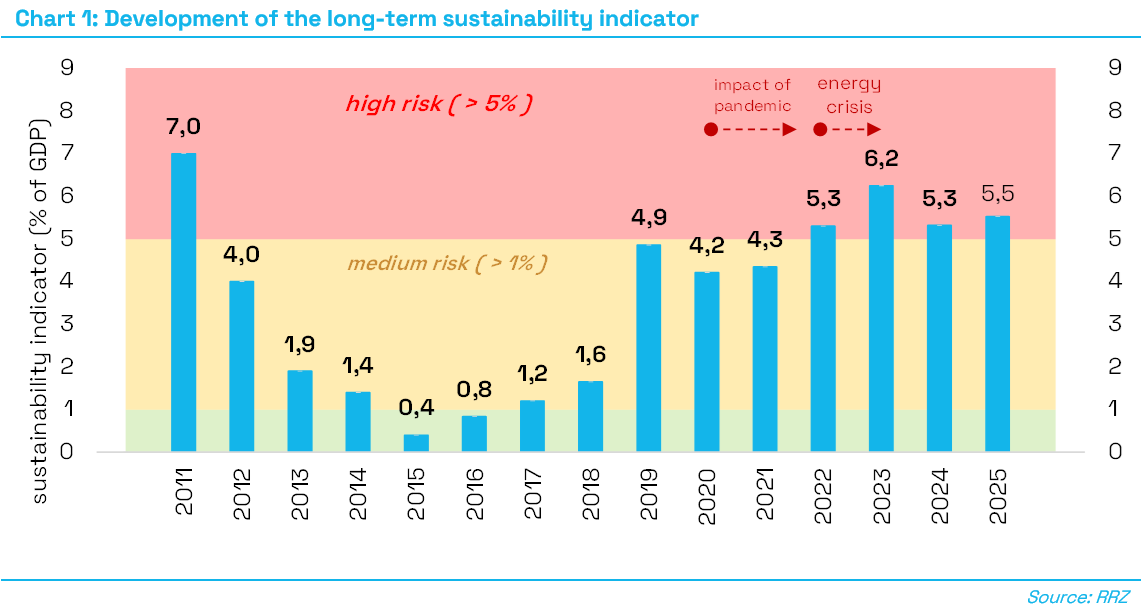
In its evaluation[3], the Council for Budget Responsibility (CBR, or Slovak abbreviation RRZ) concluded that the long-term sustainability of public finances was not achieved in 2025. Under a no-policy-change scenario, the long-term sustainability indicator reached 5.5% of GDP, placing public finances in the high-risk zone. Despite completing three rounds of consolidation measures, the indicator did not improve significantly. Its development was adversely affected by a less favourable macroeconomic environment. A more substantial improvement was also impeded by the inappropriate composition of the consolidation packages, which weakened the economy’s competitiveness[4], the adoption of new expenditure measures, and the temporary nature of some consolidation measures.
Without additional consolidation measures, the CBR estimates[5] that the deficit will increase from 4.4% of GDP in 2026 to 5.7% of GDP in 2029. Rising interest expenditure, higher defence spending and new expenditure policies are contributing to the worsening of the balance. From 2028 onwards, the expiry of temporarily increased taxes and social contributions will also have an effect. Under this scenario, gross debt would increase by 12.6 percentage points, from 61.4% of GDP at the end of 2025 to 74.0% of GDP in 2029.
Rising debt not only worsens the long-term sustainability of public finances, but also reduces their capacity to absorb unexpected shocks[6]. According to CBR estimates, the safe level of gross debt for Slovakia does not exceed 50% of GDP and, as a result of population ageing, will decline further towards 40% of GDP in the coming decades. At 61.4% of GDP, debt is therefore already above the safe range. Slovakia’s fiscal space for absorbing adverse shocks has been exhausted and its public finances are in the fiscal-stress zone. Whereas Slovakia was able to respond to past crises partly by using the fiscal space available at the time, its current absence means that even ordinary shocks may, because of the need to stabilise debt, lead to the adoption of procyclical measures with an adverse impact on households’ living standards and the economy as a whole. At the same time, Slovakia’s vulnerability to further shocks is increasing substantially. This will initially be reflected in higher financing costs, including through a higher risk premium.
Given the persistently poor state of public finances, the government should present further ambitious measures to improve their sustainability as soon as possible. In spring of 2026[7], the government significantly relaxed its own budgetary objectives and currently plans a deficit of 4.2% of GDP in 2027, followed by only a marginal reduction to 4.1% of GDP in 2028[8]. It has thus postponed reducing the deficit below 3% of GDP and stabilising debt, as required both by the government manifesto and the European fiscal rules, until after the current electoral term.
Even meeting these substantially relaxed objectives will, according to the CBR, require measures amounting to €1.2 billion (0.9% of GDP) in the 2027 election year and a further €1.0 billion (0.5% of GDP) in 2028. If the government were to meet its 2027 objective through measures that permanently improve the general government balance, the long-term sustainability indicator could move to a level between the medium- and high-risk zones[9].
Postponing consolidation without a clear strategy increases both costs and uncertainty. Persistently high deficits will increase debt and interest expenditure, while the absence of a credible medium-term plan of permanent measures reduces the predictability of fiscal policy and creates risks and uncertainty that weaken the incentives of firms and households to invest. The longer consolidation is postponed, the deeper will public finances move into the fiscal-stress zone and the less room the country will have to protect the economy and households during the next crisis. Adverse shocks are not exceptional: the pandemic, the energy and inflation crises, and the geopolitical tensions of the past decade confirm that they should be regarded as the norm. In an extreme case, the absence of a timely and systematic response could even lead to a loss of Slovakia’s fiscal sovereignty – a situation in which fiscal policy is effectively constrained by financial-market or external-financing conditions.
Formal compliance with insufficiently stringent European rules does not guarantee sound public finances. If the entire scope for net expenditure growth under the binding European trajectory were used, the deficit could reach as much as 5.4% of GDP and gross debt 73.3% of GDP in 2028. At the same time, the European expenditure rule could remain formally complied with until 2028 even if consolidation did not continue. The CBR has therefore long warned of the inappropriate calibration of the European rule for Slovakia and to the need for a substantially more ambitious domestic consolidation plan.
Fiscal responsibility rules
Safeguarding long-term sustainability is a constitutional value that all public authorities are required to protect. A fiscal position that is unsustainable in the long term may in future jeopardise the state’s ability to ensure the proper protection of fundamental rights, especially those whose protection depends on public finances[10].
To safeguard this constitutional value, the constitutional act lays down fiscal responsibility rules. Expenditure ceilings should be the main operational and countercyclical instrument of budget management. The general government debt limit, the so-called debt brake, is an ultimate corrective mechanism intended to prevent debt from remaining at excessive levels over the long term. However, several CBR recommendations to strengthen these rules have remained unimplemented for a prolonged period.
According to the intention of the authors of the constitutional act, measures associated with exceeding the sanction brackets were to reduce debt to a safe level. However, practice to this date shows that successive governments have repeatedly circumvented the obligations arising from the debt-brake sanction brackets, complied with them only formally, or failed to comply with them altogether[11]. Such conduct weakens the corrective function of the debt brake and disregards the purpose of the constitutional act, namely to achieve the long-term sustainability of the Slovak Republic’s public finances. The government’s current fiscal strategy likewise fails to create the conditions either for stabilising debt or for fulfilling the fundamental purpose of the constitutional act.
After more than a decade of the constitutional act being in force, sufficient evidence is available on how the individual rules operate and are applied in practice. The current level of debt, combined with a worsened economic outlook, also highlights the need for corrective mechanisms to operate in a timely and gradual manner and to avoid the need for sudden, large-scale fiscal-policy interventions. These circumstances do not, however, in any way justify the approach taken to date by governments and parliament towards compliance with the constitutional principles and fiscal responsibility rules. Their inconsistent application has itself been one of the main causes of the deterioration in public finances. The essential prerequisite for effectively safeguarding long-term sustainability is therefore, above all, a change in the approach of governments and parliament to the fiscal responsibility rules. Weakening the effect of the rules in force is not the solution.
In the current situation, the CBR encourages the amendment of the constitutional act. The amendment should build on the act’s original objectives and intentions and supplement the existing framework with elements enabling more effective management of public finances with a smaller potential adverse impact on the economy. A key element should be to re-link the national public expenditure ceiling to the long-term sustainability indicator, as under the original national framework in force until 31 July 2024. Such a reform requires broad political consensus. However, neither clarifying the act nor tightening sanctions will suffice without a clear and verifiable mechanism ensuring that the relevant obligations are fulfilled properly and on time.
General government debt limit
The debt-to-GDP ratio remained in the highest, fifth sanction bracket[12] of the debt-brake mechanism in 2024 and 2025. Based on data published by Eurostat in October 2025, debt stood at 59.7% of GDP at the end of 2024, while according to preliminary data[13] released in April 2026 it reached 61.4% of GDP at the end of 2025.
As the 24-month exemption from the application of the stricter sanctions under the constitutional act[14] expired on 22 November 2025, until and including 22 November 2025, the debt level recorded for 2024 was subject to the sanctions triggered by exceeding the first and second sanction brackets under the constitutional Fiscal Responsibility Act, while from 23 November 2025 it was subject to the sanctions triggered by exceeding all five sanction brackets under the constitutional Fiscal Responsibility Act[15] (Table 1).
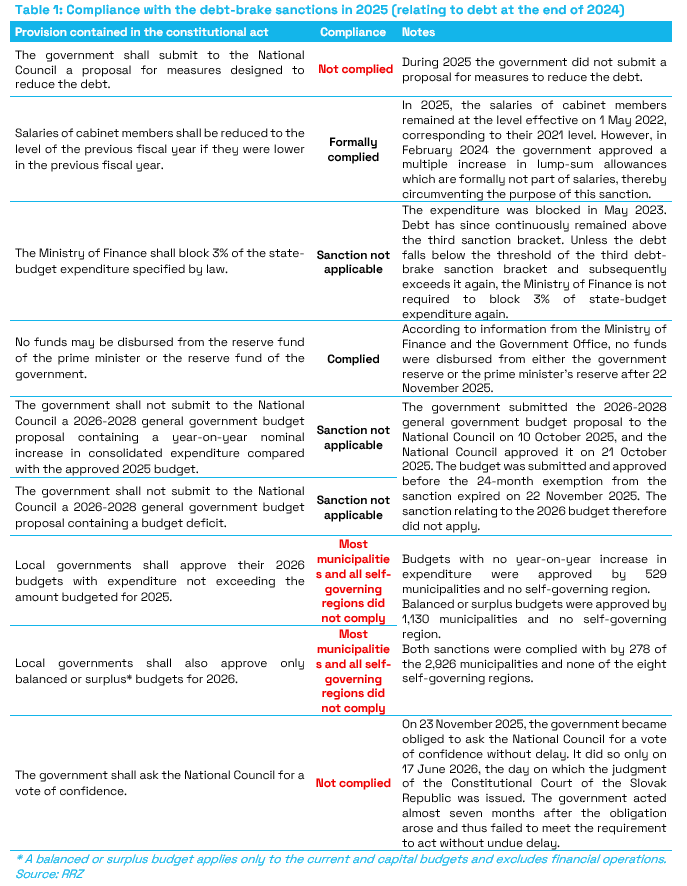
The debt level in 2025 is associated with the sanctions triggered by exceeding all five sanction brackets under the constitutional Fiscal Responsibility Act (Table 2). The debt level will be confirmed in October 2026, while compliance with some sanctions can only be assessed after the end of 2026.
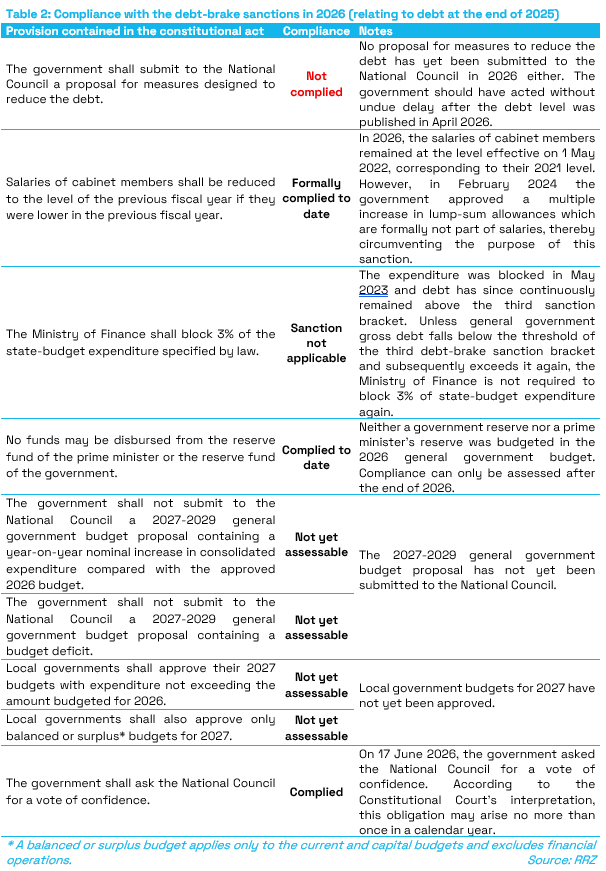
Although general government gross debt has remained continuously in the highest debt-brake sanction bracket since 2020, application of the sanctions in recent years has often remained merely formal[16] and has had only a minimal effect on reducing debt. In some cases, the government failed to comply with its statutory obligations or acted in a manner that circumvented the purpose of the constitutional act:
- In 2025, and so far in 2026, the government did not submit a proposal for measures to reduce the debt to the National Council of the Slovak Republic. The government should have submitted the proposal without undue delay[17] after the debt level was published in April. As it failed to do so, the unlawful situation persists.
- The government did not ask the National Council of the Slovak Republic for a vote of confidence without delay. The exemption from the strictest sanctions ended on 22 November 2025, and the government should therefore have asked for a vote of confidence immediately after that date. It did so only on 17 June 2026, almost seven months later and on the day the judgment of the Constitutional Court of the Slovak Republic was adopted[18]. The National Council passed the confidence vote on 18 June 2026.
- The government submitted the 2026-2028 general government budget proposal and the National Council approved it before the 24-month exemption expired. It thereby avoided the application of the obligation to submit a balanced or surplus budget proposal with no year-on-year increase in expenditure, which would have applied after the exemption expired[19].
- The Ministry of Finance recommended a similar approach to local governments[20] when approving their budgets for 2026. In the CBR’s view, however, approval of those budgets before the exemption expired did not mean that the sanctions ceased to apply to them after 22 November 2025. The CBR pointed out that local government budgets which failed to meet the requirements of the constitutional act came into conflict with its provisions once the exemption expired. Local governments should therefore have brought their budgets into line with the requirements of the constitutional act from 23 November 2025[21]. This is because the constitutional act establishes a stricter regime for local government budgets than for the budget proposal submitted by the government to the National Council.
- The CBR regards the announced use of the 36-month exemption from the strictest sanctions as a further risk of circumvention of the rules. In May 2026, the prime minister stated that the government would not prepare a deficit-free general government budget proposal for 2027 because, in his view, the conditions for this exemption had been met. Based on the information published to date, however, the CBR considers that the conditions for applying the 36-month exemption have not been met.
The CBR emphasises that, while debt-brake sanctions apply primarily to the government, ultimate responsibility for compliance with them and for the long-term sustainability of public finances lies with the National Council of the Slovak Republic. If parliament allows the government not to submit measures to reduce debt (or to submit them only as a purely formal exercise, as in the past), or if parliament expresses confidence in the government without the government demonstrating a credible strategy at least to stabilise debt, parliament thereby assumes responsibility for the constitutionally required safeguarding of the long-term sustainability of the state’s public finances.
Public expenditure ceilings
The constitutional act requires the introduction of binding public expenditure ceilings. Since 1 August 2024, the national ceiling has been linked to the net expenditure growth path under the European fiscal rules. According to the CBR, this change weakened the original framework because it does not take account of the long-term sustainability of public finances over a 50-year horizon and does not ensure full consistency between the national and European rules.
The insufficiently stringent expenditure ceilings did not create pressure for a year-on-year reduction in the deficit in line with their objectives; instead, they formally permitted a substantial increase in the deficit in 2025.
Both ceilings were complied with by a wide margin in 2025. After taking the defence escape clause into account, cumulative net expenditure growth in 2024 and 2025 reached 3.3%, whereas the European trajectory allowed growth of up to 10.3%. The national ceiling of €61.1 billion was complied with by a margin of €1.4 billion. This large margin, however, points to the rules being set too loosely: if the European ceiling had been used in full, the deficit could have risen to as much as 7.3% of GDP in 2025[22], or to 6.0% of GDP if the national ceiling had been used in full. This also illustrates the inconsistency between the European and national fiscal frameworks.
The current calibration of the ceilings does not exert sufficient pressure to achieve sustainable public finances. In the CBR’s view, the European rule could remain formally complied with until 2028 even without further consolidation measures. If the permitted expenditure path were used in full, the deficit would reach as much as 5.4% of GDP and gross debt 73.3% of GDP in 2028. In their current form, the expenditure ceilings therefore fail to ensure the necessary deficit reduction, debt stabilisation or achievement of long-term sustainability and allow the necessary consolidation to be postponed to later years.
Specific provisions for local government
The rules applicable to local government are intended to separate local governments’ responsibility for their own solvency from that of the state, ensure state funding for their new tasks, and limit excessive local government indebtedness. For these reasons, three areas are assessed: (1) state participation in ensuring local government solvency; (2) financial coverage of new tasks and competences; and (3) compliance with the debt limit.
- Based on the information obtained, it can be concluded that in 2025 the state did not participate financially in ensuring local government solvency, which is consistent with the requirement of the constitutional act to ensure budgetary discipline and a clear allocation of responsibility to local governments for the exercise of their powers. During 2025, the government did not provide local governments with any new repayable financial assistance from the state’s financial assets. However, it improved their financial position through earmarked grants and the partial remission of assistance provided earlier[23]. The rules for providing repayable financial assistance from the state’s financial assets should be amended to prevent the selective favouring of local governments and the use of such assistance to avert their insolvency.
- In the CBR’s view, the Social Services Act, as amended in 2025, assigned new tasks within the own competences of self-governing regions without full financial coverage from the state. The obligation to fund non-public providers of facilities for older people and residential care facilities is being transferred gradually from municipalities to self-governing regions from 1 July 2026 and 1 January 2027. After taking into account the increase in the share of self-governing regions in personal income-tax revenue from 28.6% to 29.3% from 1 January 2027, the CBR estimates the unfunded impact on their budgets at approximately €18 million per year from 2027[24], [25].
Changes to local government funding should be subject to a proper consultation procedure, their budgetary impacts should be quantified separately and subsequently monitored. New tasks within local governments’ own competences must be adequately funded, while the state must cover the costs of delegated state-administration tasks.
- All self-governing regions complied with the debt limit[26], but several municipalities exceeded it. For 2024, after statutory exemptions had been taken into account and the reported data verified, fines were imposed on five of the 26 municipalities initially identified. For 2025, 17 municipalities are preliminarily at risk of receiving a fine, while the reported data are still being verified. A further 22 municipalities were contacted because they had not submitted the required financial statements. Although the Ministry of Finance has assessed compliance with the debt rule and imposed fines since 2015, it has not yet published a single evaluation. The CBR therefore recommends that the Ministry of Finance transparently disclose[27] all information relating to the verification of local government debt and the imposition of fines.
Fiscal transparency rules
The fiscal transparency rules defined by the constitutional act were largely, but not fully, complied with. The tax revenue forecast approved by the Committee for Tax Forecasts was not published by 15 February 2025, as required by the constitutional act[28]. The 2026-2028 general government budget contained all the data required by law except for information on most companies in which the Ministry of Health of the Slovak Republic holds an ownership interest (Debitum, a.s., health-care facilities and Všeobecná zdravotná poisťovňa). The annual summary report for 2024 contained all the data required by law.
The CBR also assesses fiscal transparency in terms of the informational value and comprehensibility of the information contained in the documents under review, the consistent application of the ESA 2010 methodology, and the degree of parliamentary control over budget approval and execution. No progress has been made in the areas addressed by the CBR’s recommendations in its August 2025 report[29]. On the contrary, the availability of information on the actual state of public finances deteriorated, as, unlike in previous years, the government did not publish the expected development of general government revenue and expenditure excluding additional measures – the so-called fiscal outlook. It is therefore unclear what scale of consolidation measures it assumes in the coming years.
According to the CBR, the most significant persisting shortcomings, whose removal would help improve fiscal transparency and the budgetary process as a whole, include the following:
- The general government budget was aligned with the budgetary objectives only for 2026. To meet the budgetary objectives for 2027 and 2028, it lacked specific measures amounting to 1.6% and 1.8% of GDP, respectively. Nor did the amended public expenditure ceilings, which are linked to the reformed European fiscal rules and assess compliance only for the following year, make the preparation of the three-year budget more binding.
- The legislative framework for approving the budget in the National Council of the Slovak Republic is inadequate in terms of both the subject matter and the content of the documents being approved. The National Council approves only the cash-based state budget for the following year. This historically established model does not capture the key parameters of public finances as a whole or all changes to them under the European standards defined by the ESA 2010 methodology.
- Moreover, given the importance of the document, the process for approving the 2026-2028 budget was disproportionately short[30]. It limited the scope for informing the public and members of parliament, curtailed the discussion in the National Council’s Committee on Finance and Budget, to whose hastily convened meeting the CBR was not invited in advance[31], and reduced the quality of public, expert and parliamentary scrutiny.
- Transparency on the expenditure side of the budget remains low. Following the repeal of the statutory requirement to prepare the budget on the basis of a no-policy-change scenario[32], the impact of incorporated measures is not quantified, except for health-care expenditure. Transparency is also reduced by the fact that certain expenditures originally classified as budget reserves continue to be budgeted centrally under the General Treasury Administration chapter, but now as ordinary expenditure items[33]. In substance, they continue to function as reserves: when the budget is approved, they are not allocated to specific budget chapters and their final use is determined only during the year[34]. As the quarterly reporting obligation applies only to reserves defined by law[35], the regular publication of comparable information on transfers and the use of funds is not guaranteed for these expenditures. This makes ongoing scrutiny by the National Council and the public more difficult.
- Information on state-owned enterprises should be improved. Adding a brief commentary on the expected financial performance of individual enterprises would allow a better assessment of the risks arising from the performance of enterprises owned by the state or by MH Manažment, a.s.
- The informational value of the net-worth indicator would be enhanced by valuing the components that have not yet been quantified; the Ministry of Finance should assign greater priority to this task and present concrete results within a reasonable period[36]. For a more detailed assessment of the impact of government measures on net worth, it is also necessary to create the technical conditions for data collection and, in co-operation with the CBR, define a methodology linking changes in net worth to the budget balance.