Slovakia faces rising expenditures due to adverse demographic developments, adding pressure to public finances[1], which are already showing exceptionally high deficits. Preparing reports on the long-term sustainability of public finances is one of the core responsibilities of the Council for Budget Responsibility (CBR), as defined by the constitutional Fiscal Responsibility Act[2]. These sustainability reports assess whether the current public policy framework is fiscally sustainable in the long term, based on projected demographic and macroeconomic developments.
Long-term sustainability of public finances in 2025 is in the high-risk zone
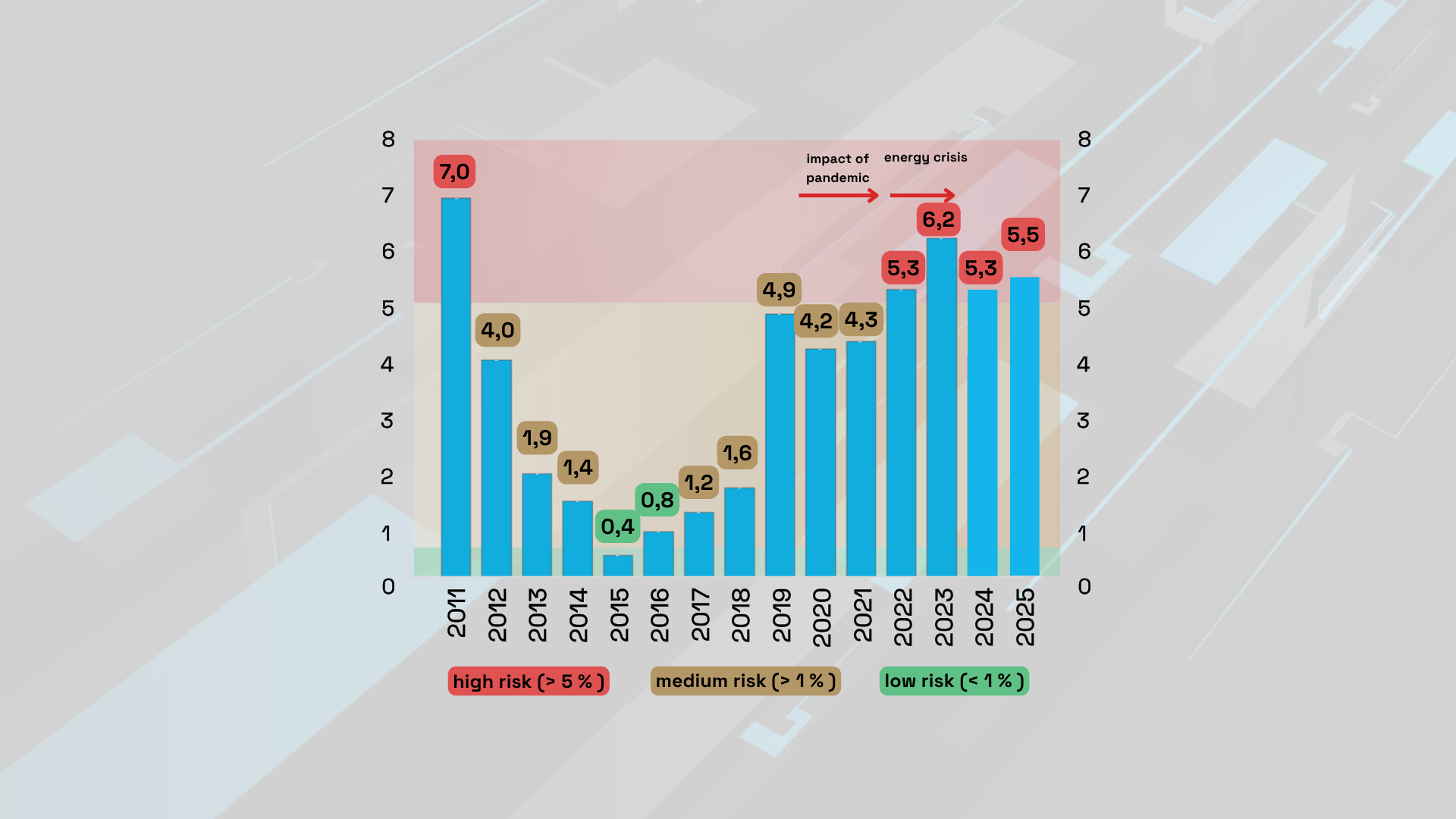
The baseline scenario in this report reflects Slovakia’s fiscal position at the end of 2025, incorporating the impact of measures adopted throughout the year. The long-term sustainability indicator reached 5.5 percent of GDP (EUR 7.9 billion), corresponding to the high-risk zone[3]. This means that long-term sustainability was not achieved in 2025[4] and the fiscal burden continues to be shifted onto future generations. Achieving long-term sustainability would therefore require the adoption of permanent measures improving the general government balance by approximately 5.5 percent of GDP. Part of this improvement could also come from structural reforms supporting economic growth.
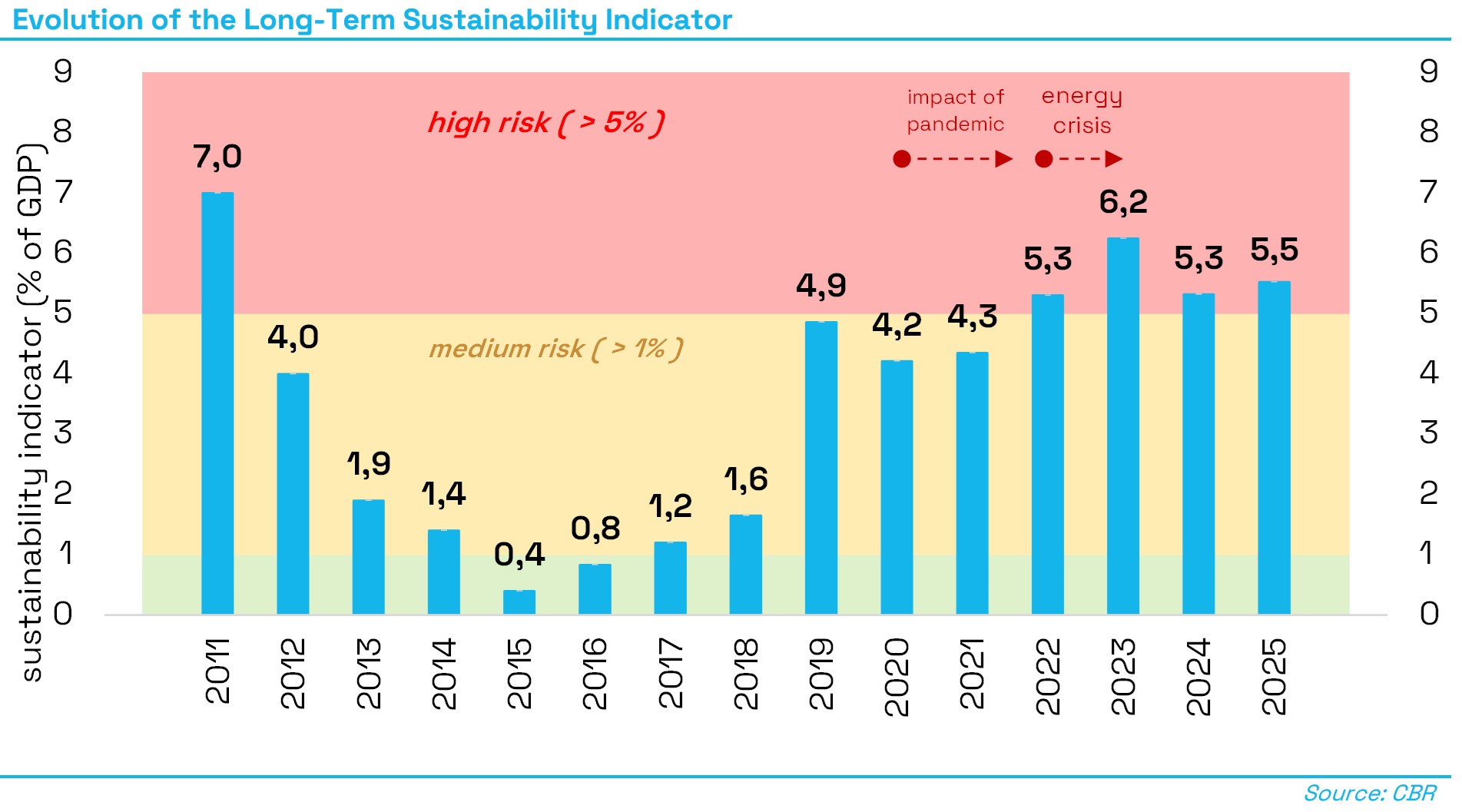
Despite three rounds of consolidation measures adopted over the past three years, the long-term sustainability indicator has not improved significantly and remains in the high-risk zone. This trend is significantly influenced by a less favourable macroeconomic environment, shaped not only by external factors (high uncertainty, trade conflicts, geopolitical tensions) but also by domestic factors. These include, in particular, the composition of consolidation packages that erode the competitiveness of the economy and substantially dampen economic activity even over the medium term.
A crucial role is played by the fact that, alongside consolidation measures, additional expenditure-increasing measures were adopted, thereby undermining their overall impact on the deficit and public debt. Moreover, some of the consolidation measures are temporary in nature. If not extended, they will automatically contribute to growing general government deficits in the coming years. From this perspective, the packages adopted in particular in 2023 and 2025 represented a missed opportunity for a more significant improvement in long-term sustainability.
Consolidation has also relied heavily on revenue increases, which narrows the room for further necessary measures. The composition of consolidation is crucial: it should not undermine competitiveness or reduce the investment attractiveness of the economy, as lower growth in the future means lower revenues for the state. A risk to its continuation lies in the political climate of an election year, a time when governments are generally reluctant to implement consolidation measures. Related to this is the possible consolidation fatigue, as the three packages adopted so far have not delivered an adequate reduction in the deficit relative to their scale[5].
This is taking place at a time when the European fiscal rules are not calibrated correctly for Slovakia, and formal compliance with them may be accompanied by a significant increase in public debt towards a level of 70 percent of GDP. The government also approaches the fiscal responsibility rules in a rather formalistic manner and does not comply with the sanctions of the so-called debt brake. Last year, measures to reduce debt were not submitted to the National Council of the Slovak Republic despite the requirement of the constitutional Fiscal Responsibility Act, and the previously adopted measures proved insufficient. Furthermore, the government is unjustifiably delaying the application of the highest sanction, which is the obligation to seek a parliamentary vote of confidence.
The causes of unsustainability lie in the current state of public finances as well as in future costs associated with population ageing
Gross general government debt reached a historically high level of 61.4 percent of GDP at the end of 2025, significantly above the upper limit set by the constitutional act. The structural primary deficit of general government, which is directly decisive for long-term sustainability, reached 2.9 percent of GDP, representing a slight improvement compared to 2024. However, this is largely the result of revenue-side consolidation adopted in 2024, while the situation was worsened by new expenditure measures and the government’s own fiscal performance, particularly regarding operational expenditure.
The current state of public finances — the high level of the structural primary deficit and debt exceeding the upper limit set by the constitutional act — contributes negatively to long-term sustainability to the extent of 2.7 p.p. The current deficit of the pension system[6] alone accounts for 1.5 percent of GDP of this contribution[7].

The negative long-term outlook is also contributed to by the expected increase in age-sensitive expenditure and other implicit liabilities, with a total contribution of 2.5 p.p.
The area of long-term care represents the greatest objective need for additional expenditure in the context of population ageing, with an estimated increase of 0.9 p.p. Without achieving a fundamental improvement in the long-term sustainability of public finances, it is the system of care for predominantly older adults and other people with disabilities that will face the highest risk of underfunding.
There will also be an increase in pension system expenditure (0.7 p.p.). The total permanent burden on public finances from the pension system, combining the current (permanent) deficit and future claims, amounts to 2 percent of GDP. This represents as much as 36 percent of Slovakia’s total long-term sustainability problem.
Growing healthcare costs and a decline in property income will also contribute to the deterioration (each by 0.6 p.p.). Conversely, the estimated decline in social transfer expenditure has a slightly positive impact (0.3 p.p.).
The 2025 consolidation package improved the indicator, but new expenditure measures offset the gains
Year-on-year, the long-term sustainability indicator deteriorated from 5.3 percent of GDP (revised value for 2024) to 5.5 percent of GDP in 2025, i.e. by 0.2 percentage points.
The most significant positive contribution of 1.0 percent of GDP came from the consolidation package approved in autumn 2025 with effect from 2026. The package included, in particular, an increase in the employee health contribution rate by 1 percentage point, an increase in the progressivity of personal income tax, the abolition of contribution holidays and an increase in minimum social contributions for the self-employed, changes to VAT, and a freeze on public sector wages.
However, this gain was offset by new expenditure-increasing measures and a less favourable fiscal outturn in 2025 relative to the no-policy-change scenario:
- A 7 percent increase in wages for education sector employees from September 2025 and a further 7 percent from January 2026 worsened the indicator by 0.3 percent of GDP, as it was not fully offset.
- The necessary reform of long-term care financing worsens the indicator by 0.3 percent of GDP, as it was likewise not offset.
- Healthcare measures and the compensation of maternity periods in the pension system each contributed to a deterioration of 0.1 percent of GDP.
- The fiscal outturn in 2025, adjusted for the impact of temporarily lower investment and defence expenditure, contributed to a worsening of the indicator by 0.3 percent of GDP. The main reasons are higher operational current expenditure and lower tax and contribution revenues.

Updated macroeconomic outlook and lower growth potential deepens the sustainability problem
The Slovak economy is growing very slowly — at around only 0.8 percent in both 2025 and 2026 — and the outlook is marked by several simultaneous threats. The consolidation package for this year is simultaneously dampening the economy, primarily through an increase in the labour contribution burden. Geopolitical turbulence, tariffs, and ongoing armed conflicts are adversely affecting external demand. Energy-intensive industry with high unit labour costs is losing competitiveness in global markets.
Over the medium term, economic growth should recover to levels exceeding 2 percent per year, but over the long term it will gradually slow to around 1 percent per year in the period around 2050, when the cumulative decline in the labour force will be most pronounced.
The more conservative economic outlook has directly translated into a deterioration in long-term sustainability. The macroeconomic forecast update alone contributed to a worsening of the revised 2024 indicator by 0.6 p.p. This effect is the most significant single factor behind the revision of last year’s assessment (and likewise affected the 2025 assessment to the same degree). This reflects primarily the impact of external factors as well as the effects of consolidation to date on the future competitiveness of the economy. Public expenditure has a high degree of inertia in the short and medium term and does not adjust to the fundamental deterioration in our economy’s potential. Some external shocks also directly increase public expenditure, e.g. energy costs or pensions. This is why repeated negative macroeconomic shocks have so rapidly and significantly worsened the sustainability of public finances.
Additional factors behind the revision of last year’s sustainability assessment included the deterioration in the estimated effects of adopted measures (for example, the financial transaction tax is being collected at a lower rate than originally assumed), contributing 0.3 p.p., as well as less favourable tax collection, contributing 0.1 p.p.
The greatest risks are linked to possible pension measures, growth-unfriendly economic policy, and unjustified delays in consolidation
Sensitivity analysis shows that the most significant risk of deepening the long-term sustainability problems would be a potential reversal of pension system reforms, in particular the re-capping of retirement age combined with more generous indexation and fixing the replacement rate for new pensions. This combination of measures has the potential to worsen long-term sustainability by 2.1 p.p.
A slow pace of consolidation also represents an additional risk to long-term sustainability. If the goal of achieving sustainability were spread over as long as 10 years[9], the additional costs arising from the delay in consolidation would amount to approximately 0.8 p.p.
Persistently less favourable macroeconomic developments — a combination of higher interest rates, weaker productivity growth, and higher structural unemployment — would worsen the long-term sustainability indicator by a further 0.7 p.p.
Fiscal burden shifted to future generations
Generational accounts confirm the transfer of the fiscal burden to future generations. The average person born in 2025 will receive EUR 126,000 more from public finances over their lifetime than they will contribute. The living population will also generate an additional burden of 89.4 percent of GDP over the remainder of their lifetimes, an increase of 3 p.p. compared to 2024. If future generations were to cover these liabilities together with the existing net debt (54.4 percent of GDP), each person would have to pay EUR 110,000 more over their lifetime than they would receive from the budget.

