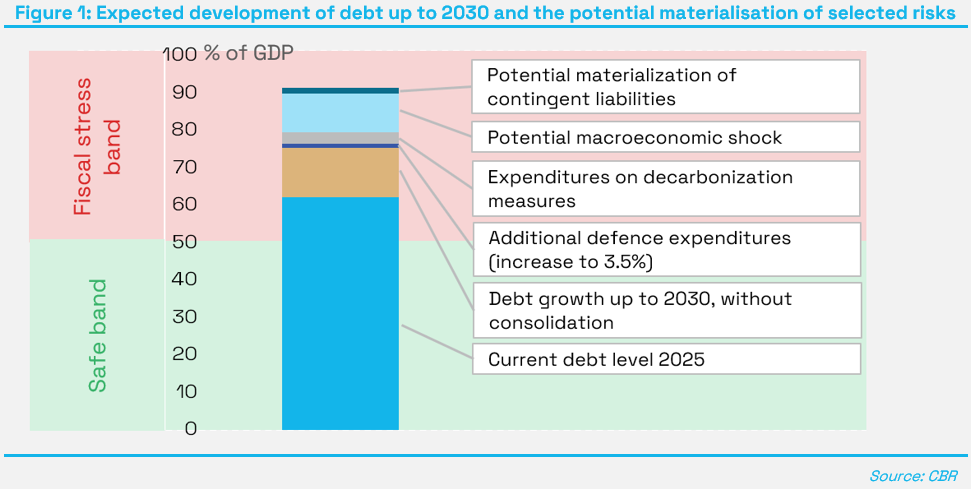
- Slovakia's fiscal space for absorbing the impacts of negative shocks is exhausted. General government debt exceeds 60 % of GDP, well above the safe level for Slovakia of below 50 % of GDP, and without additional measures it is heading towards 75 % of GDP by the end of the decade.
- Slovakia is in the zone of fiscal stress. In the past, Slovakia addressed crises by drawing on its fiscal space; its absence means that even ordinary shocks may force pro-cyclical measures that harm the economy and living standards. Vulnerability to further shocks is rising, translating first into higher financing costs and a higher risk premium.
- The safe level of debt will continue to decline even without new crises. Ageing raises expenditures and weakens the ability to stabilise debt: by 2075 it adds 97.5 % of GDP to debt and cuts the safe level of debt by some 10 % of GDP.
- The identified fiscal risks may materialise simultaneously and their impacts are amplified. A deeper recession could raise debt by more than 10 % of GDP, to well above 80 % of GDP; combined with other factors (e.g. forced higher defence spending), the increase would be even sharper.
- Fiscal policy must move from a reactive to a proactive risk management regime with clear institutional anchoring at the technical and political level. Restoring fiscal space is a necessary condition for managing future shocks and for financing long-term challenges. This requires measures in three areas:
- Absorption: reducing the deficit towards 2.5 % of GDP and stabilising debt; in favourable periods, moving towards a balanced budget for a faster decline in debt.
- Prevention: systematic reduction of risk exposures (state-owned enterprises, guarantees, investment debt), budgetary coverage of identified risks, and modernising the economy to raise its growth potential.
- Preparedness: building crisis mechanisms and plans for managing shocks without undermining long-term sustainability.
- Without fiscal space, the economic and social costs of crises increase. In the extreme, the absence of a timely response may cost Slovakia its fiscal sovereignty - fiscal policy would be dictated by financial markets or by the terms of external financing.
Summary
This report provides a systematic view of fiscal risks and of the state of resilience of Slovakia's public finances. The CBR regularly publishes analyses focused on individual areas of fiscal policy, but these capture risks separately, over different time horizons, and do not provide an overall picture of their combined effect. The experience of international institutions (IMF, OECD), of independent fiscal councils, as well as the practice of other countries show that the long-term sustainability of public finance can be supported by a systematic assessment of fiscal risks together with an estimate of fiscal space, which determines a country's ability to deal with materialised risks.
Fiscal policy must work systematically with uncertainty, rather than proceed from the assumption of a stable environment. Over the past decade Slovakia has faced a series of pronounced negative shocks which fiscal policy did not anticipate. The COVID-19 pandemic, Russian aggression in Ukraine and the resulting energy and inflation shock, another energy shock owing to the war in Iran, and trade wars have fundamentally affected the economy and public finances. These events show that risks emerge repeatedly, often accumulate, and their impacts are amplified. At the same time, even risks that appear in forecasts as hypothetical scenarios often materialise sooner or later, even though their exact scale and timing cannot be determined in advance. Fiscal policy therefore cannot be based solely on the “central scenario”, but must work systematically with all risks, including extreme events.
The ability of public finances to absorb fiscal risks depends on the existence of fiscal space. It makes it possible to respond to negative shocks by a temporary increase in debt without jeopardising its sustainability. In this document, fiscal space is defined as the positive difference between the current level of debt and the boundary of the safe zone. If this difference is negative, fiscal space is exhausted and debt lies in the zone of fiscal stress. A further increase in debt leads first to a rise in the risk premium and may result even in the loss of access to financial markets. In such situations, stabilising debt requires rapid and substantial consolidation at an inopportune time, often with pro-cyclical negative impacts on the economy and on living standards.
According to CBR estimates, the safe level of gross debt for Slovakia does not exceed the level of 50 % of GDP. This is not a fixed threshold of the collapse of public finances, but a level of debt associated with an acceptable minimum probability of fiscal failure. The estimate is based on a combination of approaches taking into account the probability of shocks, the ability of fiscal policy to stabilise debt, and also the impacts of indebtedness on the economy. The stochastic approach suggests a safe level of debt of around 30 to 45 % of GDP, the fiscal limit model approximately 35 to 50 % of GDP and the fiscal reaction model approximately 35 % of GDP. Approaches focused on growth and welfare estimate the optimal level of debt in the range of 30 to 50 % of GDP. The estimated safe level of debt is thus fully in line with the legislative setting of the debt brake, which implicitly aims at maintaining gross debt below the level of 50 % of GDP, with sanctions already from 40 % of GDP.
The development of Slovakia's public finances shows that fiscal space has not been restored over the long term. After the global financial crisis subsided, sufficient consolidation did not take place and Slovakia entered the COVID-19 pandemic with an already elevated level of indebtedness, exceeding the first sanction band of the debt brake, which subsequently exceeded 60 % of GDP. Each successive crisis thus began from a worse initial position, which gradually increased the vulnerability of public finances. Experience also shows that the materialisation of a negative shock as a rule causes a rapid and pronounced deterioration of the balance and of debt, whereas the return to a sustainable trajectory is subsequently slow, requires extensive measures and entails higher economic, social and political costs.
The baseline scenario of public finances suggests a deterioration of the fiscal position even without new shocks. Fiscal risks do not operate in isolation, but against the background of the baseline scenario, which is already affected by predictable structural pressures. The most significant of these is ageing, which systematically increases expenditures on pensions, healthcare and long-term care and at the same time weakens the growth potential of the economy. The baseline scenario implies a rising debt trajectory even without the materialisation of fiscal risks. These pressures also reduce the ability to stabilise debt, so that fiscal space will gradually shrink even without active fiscal policy decisions, since the level of debt that can be considered sustainable is declining.
The analysis of fiscal risks does not serve to create alternative forecasts, but to capture the uncertainty associated with the future development of public finances. General government debt is, moreover, only one part of the state's overall fiscal position. The broader concept of net worth also takes into account current and future assets and liabilities and in this report serves as a framework for the most complete possible identification of risks, although, owing to data and methodological limitations, it is not quantified directly. It is a systematic assessment of factors that may expose public finances to additional pressures beyond the baseline scenario. Risks may be of both a positive and a negative nature; the fundamental problem, however, tends to be the systematic underestimation of negative shocks.
The dominant fiscal risks are of a systemic nature and affect several sectors of the economy at once. These are in particular macroeconomic shocks and geopolitical events, which may rapidly and substantially worsen both the balance and debt. Structural pressures (ageing) and risks (climate challenges, investment debt) act more slowly, but cumulatively. Specific risks (e.g. the financial performance of state-owned enterprises and hospitals,) as a rule have a lower individual impact, but their simultaneous materialisation may be a problem.
- Macroeconomic shocks and financial crises remain the most likely and historically most costly risk. Experience suggests that a more serious economic shock occurs approximately once a decade. The simulated risk scenario shows that another deeper recession could move Slovakia's debt significantly above 80 % of GDP. Economic crises typically increase debt by up to 9 % of GDP over a short period; in combination with stress in the financial sector the increase may be even higher.
- Geopolitical risks have changed from hypothetical into permanent commitments. For example, the increase in defence expenditures to 3.5 % of GDP alone may increase debt by approximately 7 % of GDP (in 2035) if it is not accompanied by compensating measures.
- Structural risks represent a long-term and cumulative pressure on Slovakia's public finances. The investment debt, climate change or the loss of competitiveness do not act as one-off shocks, but manifest themselves gradually through the growth of expenditures or the weakening of the revenue base. Their impact accumulates over time and may range between 2 and 10 % of GDP over a longer horizon.
- Specific risks have a lower individual impact, but their simultaneous materialisation may be fiscally significant. PPP projects, the financial performance of local governments, or problems in the drawdown of EU funds as a rule represent a risk of up to 2 % of GDP individually, but in combination they may create significant additional pressure. Contingent liabilities and the financial performance of state-owned enterprises and hospitals are classified among the medium-sized specific risks.

Fiscal policy must move from a reactive to a proactive risk management regime. This means working systematically with uncertainty even before shocks materialise and creating the conditions for managing them without destabilising public finances. The resilience of public finances rests on three complementary pillars:
- Absorption capacity (fiscal space). The basis of resilience is sufficient fiscal space created above all in favourable economic conditions. A country should be able to deal with one large (systemic) shock, or with a chain of several smaller and medium-sized shocks.
- Prevention and reduction of exposures. Some risks cannot be eliminated, but for many of them the probability of occurrence or the scale of the impact can be reduced. This requires an appropriate legislative setting, rigorous oversight of state-owned enterprises, continuous reassessment of contingent liabilities, transparency and annual budgetary coverage of measures for the continuous resolution of identified risk areas (e.g. investment debt, cyber security). Prevention can also include supporting the diversification of sectors of the economy or supporting the diversification of suppliers of key raw materials.
- Consequence management mechanisms (crisis preparedness). In the case of shocks that cannot be eliminated, it is key to have clear procedures, resolution tools and crisis mechanisms in place that allow a rapid and coordinated response. These are frameworks for stabilising the financial sector, managing state-owned enterprises, or activating temporary budgetary measures without undermining long-term sustainability.
Not all fiscal risks require an immediate and full response, but all of them require a clear strategy and the correct timing of measures. The differing probability, intensity and time profile of costs mean that the response of fiscal policy must be prioritised and phased over time. The safe zone of debt is lower than the current level of around 60 % of GDP. If Slovakia is to be able to absorb a larger macroeconomic shock with an impact on debt exceeding 10 % of GDP without a sharp increase in the risk premium and the risk of default, it should implement steps to reduce debt significantly below 50 % of GDP. At the same time, without prevention and preparedness, shocks are addressed exclusively through higher debt – which is the most costly form of building resilience.
- The priority for the coming three years must be to halt the growth of debt and not to deepen fiscal stress. This means, as a first step, reducing the deficit towards the level of 2.5 % of GDP over the medium term. In parallel with reducing the deficit, it is necessary to implement reforms that increase the growth potential, which mitigate the immediate impacts of consolidation and also the long-term pressures on public finances. Consolidation is, however, at present already a necessary condition for sustainable economic growth.
- Over a horizon of three to ten years, the objective should be the gradual restoration of the fiscal buffer and the reduction of exposure in risk areas. After debt has been stabilised, further movement towards a balanced budget in favourable periods is necessary so that debt begins to decline more rapidly. The monitoring of risk areas concerns above all the reduction of the investment debt, state-owned enterprises and the guarantees provided.
- Over a horizon of approximately ten years it is necessary to create a stable framework for financing long-term structural challenges – risks and trends. This concerns in particular the challenges associated with climate change and demographic changes, the failure to address which may lead to crises with systemic potential.
Slovakia does not yet have a framework in place for the systematic management of fiscal risks. The Ministry of Finance of the Slovak Republic, in cooperation with the IMF, is preparing a proposal for the monitoring and management of fiscal risks. According to the CBR, an effective arrangement should combine active risk management by the Ministry of Finance with independent analytical assessment by the CBR, the SAO and the NBS, which reduces the risk of underestimating threats and strengthens the credibility of fiscal policy. The analytical level must systematically identify, quantify and evaluate risks, while the political level bears responsibility for their prioritisation and for the implementation of measures.
In an environment of high indebtedness and strong demographic pressures, building resilience becomes a condition for preserving fiscal sovereignty. Publishing comprehensive assessments of fiscal space improves the quality of decision-making by providing a coherent picture of risks and by refining the interpretation of developments in public finances. In an environment of information asymmetry, independent assessment helps to distinguish between the consequences of adverse circumstances and those of political decisions, thereby strengthening the government's accountability and voters' awareness. The aim of this report is therefore not only to increase transparency, but above all to contribute to making the management of fiscal risks an integral part of budgetary policy and to strengthening the resilience of public finances.
As part of its regular monitoring, the CBR will, alongside this report and its updates, publish analytical studies focusing on selected types of the identified risks.